Showing posts with label death becomes us. Show all posts

Tuesday, December 3, 2024

Mahakali's Kiss


Mahakali's Kiss
 
 
I'm told it rained on the day she was born,
a January Sunday on streets of snow
that melted away like the life she wore,
like time's black kiss, like a riot of crows.

She makes each thing with a blind innocence
that starts a smolder in a long-dry field
just to leave an ash that cannot rest
til love itself belongs to the dead.

So fill your mouths with her acid, boys,
that seems to taste as sweet as mead.
Fill your arms with her empty husk
whose midnight touch will make you bleed

and when lips rot and skin weeps red
remember her smile and the charm she said
to reap your heart in her willow bed
where she dies of cold as soon as she's fed.


December 2024


at Shay's Word Garden


Process notes:  Mahakali means 'Great Kali,' and is the honorific title of the Hindu goddess of Time, Death and Liberation, Kali, whose name translates as "she who is black" or "she who is the ruler of time." wikipedia: "Mahakali, in Sanskrit, is etymologically the feminized variant of Mahakala or Great Time (which is interpreted also as Death). Mahakali...serves as the agent who allows the cosmic order to be restored.." 


Image: Goddess Mahakali, Delhi Museum via wikipedia   Public Domain

Tuesday, February 1, 2022

Two Crows Make A Zodiac


Two Crows Make A Zodiac


Winters at white dawn, before the first gaudy ransack of a
scold of jays, two crows come to her feeding cup.

They have no elfish hands to hold interwoven as otters 
do, to keep each other close on cold waters, but still

they float down on air as joint motif. Not one crow,
but two, for in any functional lexicon, the complete set
 
of meaningful units is not one. They eat a dozen peanuts
with the focus she applies eating her mistakes, but with
 
their own goblin squawk and savoring, a black-suited pair
laughing like undertakers on holiday, the charm of a child's
 
toys in their round eyes as they celebrate this meal,so much
more efficient than pecking through reticulated rubbish, so
 
much quicker than sieving crushed bladders or hearts tarry from
asphalt, than abrupt blare-interrupted flutters on the flat luck
 
of skunk or raccoon, where they must thrust their razor beaks 
like needles through black blood glitter, scrape hard bone
 
clean to sew lost life from ruined flesh to full feathers. They
are complete either way, but the woman has made it easier.

Two crows make their own zodiac, seven stars make Orion,
the time-twisted woman who sets out peanuts
 
makes a pageant in vapor, a blood-let of generosity,
a late arrival at sufficiency; for in any functional lexicon,
 
the complete set of meaningful units
is not one.


January 2022


 posted for
Shay's Word List #11:


This poem makes no attempt to capture  Hughes' style or Hughes' own vision of Crow and his journeys, that epic exploration of folk-tale and myth which rewards the reader's time with much more content and flourish than I could ever hope to muster. 
 
But when I think of Hughes, I think of Crow, and so, this poem.


Note: For those interested, here is some background on Hughes' collection of poems exploring Crow:
 
After his wife Sylvia Plath's suicide, Hughes wrote nothing for three years. Then he began a work which was finally published as Crow:from the Life and Songs of Crow. As stated by the Ted Hughes Society, it "holds a uniquely important place in Hughes oeuvre.  It heralds the ambitious second phase of his work, lasting roughly from the late sixties to the late seventies, when he turned from direct engagement with the natural world to unified mythical narratives and sequences. It was his most controversial work: a stylistic experiment which abandoned many of the attractive features of his earlier work, and an ideological challenge to both Christianity and humanism..He looked back on the years of work on Crow as a time of imaginative freedom and creative energy, which he felt that he never subsequently recovered...."


Images: Crows in Winter, © N.C. Wyeth   Fair Use
Detail from Crow's Song © Andrea Kowch  generously accessible at her website Andrea Kowch Studios Blog  where you can and should see the entire painting.    Fair Use

Monday, December 6, 2021

The Day Before Gone


The Day Before Gone
 
It was the day before gone.
The strophe began on
 a sun weak with fever,
a sky of grey primer 
because plague hit the painters
 before they managed the blue. 
 
The tepid air was fragrant with 
malfeasance, but the dumbshow
never paused.

It was noon on the sea of shadows.
All through the potential zeros
bug-scudding over the whine-
dark waves ran a shiver, a dread,
the sodden fog of the sailor
at the rocks too busy with rum
 and scrimshaw to have bothered
with learning to swim.
 
The sirens and the kraken laughed
in antiphons, tatting the antistrophe
 from the rust-wire wreckage.

It was the hour before the reckoning
but the only text on the wall read
"It can't happen here."
Pulpits burned, preachers prowled
like panthers
among the singed dollar bills.
 
Locusts
ate the hedge funds. Vultures ate
the venture capitalists, and
politicians ate the vultures
til the darkness seethed 
with undigested bones.

Then finally
over the feeble,
failure-fumed pandemonium
Dawn came with her
exterminator's smile.


December 2021


posted for 


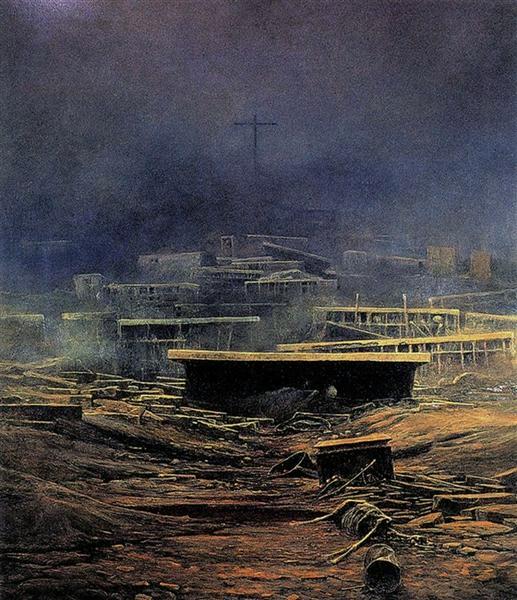
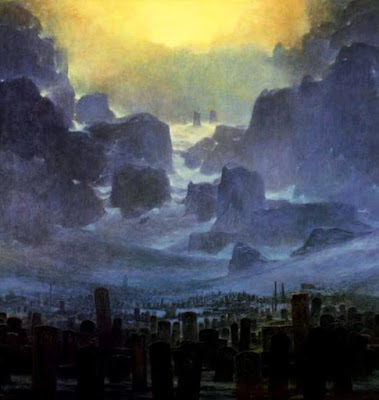
Images: Both Untitled, by Zdizlaw Beksinski, copyright held by The Histoical Musem in Sanok Poland
Fair Use